 |
| The Fall of Phaeton (Rubens) (Wikipedia) |
.jpg)
Note: The story of Phaeton feels like modern accounts of "climate chaos"--but this was caused by a spoiled son-of-a-god!
Get Ready: how do you think human action has affected global weather patterns?


|
| The Fall of Phaeton (Rubens) (Wikipedia) |
Note: The story of Phaeton feels like modern accounts of "climate chaos"--but this was caused by a spoiled son-of-a-god!
Get Ready: how do you think human action has affected global weather patterns?
 |
| A Green Man disgorging foliage (Wikipedia) |
Note: This charming legend personifies nature and gives an ancient basis to the modern push for ecological awareness.
Get Ready: Do you think it's important to be "good stewards" of the earth and its occupants? Why or why not?
 |
| Death Valley (Wikimedia) |
Note: Mary Austin's little book is a masterpiece of nature writing, a sure-fire antidote for city living.
Get Ready: What is the allure of deserted. lonely places? Why do so many seek "spiritual" experiences there?
 |
| Could this be Bigfoot? From a trail camera capture (Wikipedia) |
Note: "Bigfoot" is the subject of fairly recent urban legends, and was most likely born as a hoax, or a series of them. But that doesn't stop the true believers from truly believing!
Get Ready: Do you think Bigfoot exists? How about the Yeti ("Abominable Snowman")? Or the Loch Ness monster?
 |
| A four-man Indian rickshaw (Wikimedia) |
Note: This terrifying story comes from the same benign pen that gave us Mowgli and the "Just So stories." Be warned!
Get Ready: Isi t possible for a person's guilty imagination to cause him or her to see things, to the point of a mental breakdown?
 |
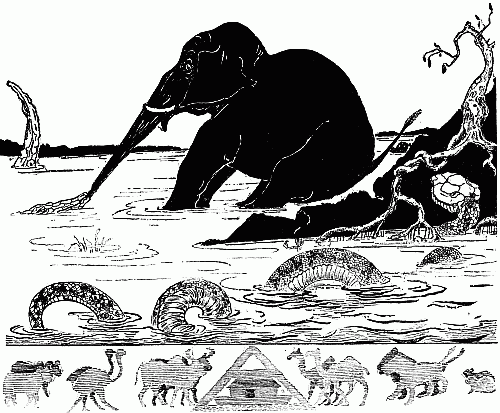
| "This is the Elephant's Child having his nose pulled by the Crocodile..." (Gutenberg) |
Note: Rudyard Kipling wrote a huge number of short stories, many of them for children. This one is from a collection that is one of his most famous.
Get Ready: Have you ever wondered why elephants' trunks are long? Here's the answer! 😉
 |
| A phoenix in a medieval bestiary (Wikipedia) |
Note: In the history of science, many imaginary animals were once thought to be real (though some were just literary inventions). Let's meet a few.
Get Ready: Can you name any imaginary animals that people once believed in?
 |
| A dog in the Yukon, 1901 (Wikipedia) |
Note: Like thousands of others, Jack London joined the Klondike Gold Rush looking for gold. Instead, he found experiences that contributed to his Call of the Wild and White Fang, as well as this jewel of a story.
Get Ready: What is the coldest weather you have ever been in? What did it feel like?
 |
| Pluto carries away Proserpine (Wikipedia) |
Note: Ancient peoples often created stories to "explain" various aspects of nature. here's one that explains how we got agriculture, and why we have winter.
Get Ready: Do you know what causes the seasons? Why do we have summer? and winter?
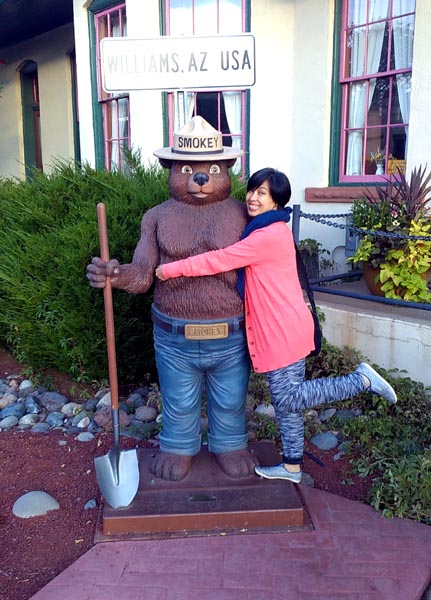 |
| My wife meets Smokey, Williams, Arizona (2015) |
Note: How a "spokesbear" rose from the ashes of a natural disaster to help prevent more such catastrophes.
Get Ready: Do you know of any public safety campaigns featuring animals as "spokesmen"?
 |
| Rikki faces Nag (Gutenberg) |
Note: This story was included in Rudyard Kipling's The Jungle Book; it is another example of the author's keen observations of interactions between the animals of India.
Get Ready: Have you ever had an unusual pet? Or do you know anyone who has? What was it like?
 |
| Hawk-eye, disguised as a bear, fights Magua in the cave where Alice is held captive. (Wikipedia) |
Note: James Fenimore Cooper captured the historic imagination of America--and in the process irritated Mark Twain. Let's see if we can figure out why.
Get Ready: Do you prefer stories that are simple and straightforward? Or would you rather read one with lots of complications and "twists and turns"? Why?
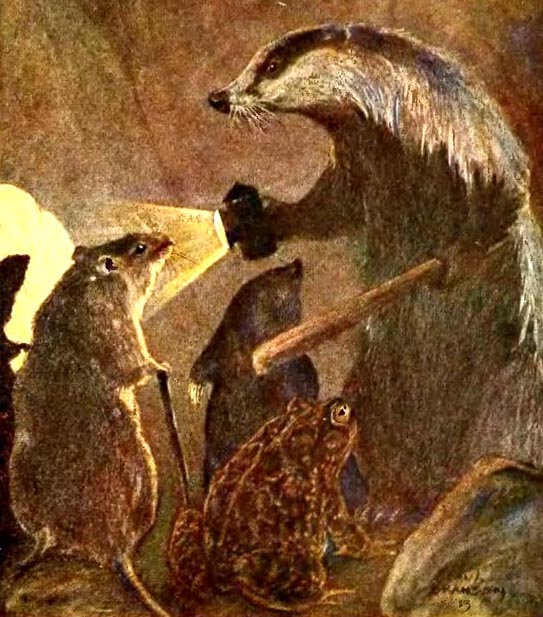 |
| "The Badger said, 'Now then, follow me!'" (l to r, Rat, Mole, Toad, and Badger) (Wikipedia) |
Note: Read the adventures of four animal friends who enjoy "messing about in boats"--when they're not trying to get their friend Mr. Toad out the predicaments he keeps getting himself into!
Get Ready: What can you do with a friend who is "too much," always getting himself (and sometimes others) in trouble?



.jpg)


