 |
| (Wikimedia) |
Note: Some people think that the giver in this song gave only one partridge in a pair tree. But it was twelve!
Get Ready: Do you know a formula for adding tetrahedral numbers? Look at this.


|
| (Wikimedia) |
Note: Some people think that the giver in this song gave only one partridge in a pair tree. But it was twelve!
Get Ready: Do you know a formula for adding tetrahedral numbers? Look at this.
 |
| A cartoon dragon (probably not "Puff") (Wikimedia) |
Note: This sweet nostalgic story has been a favorite for generations--and it's fun to sing!
Get Ready: What do we gain by growing up? What do we lose?
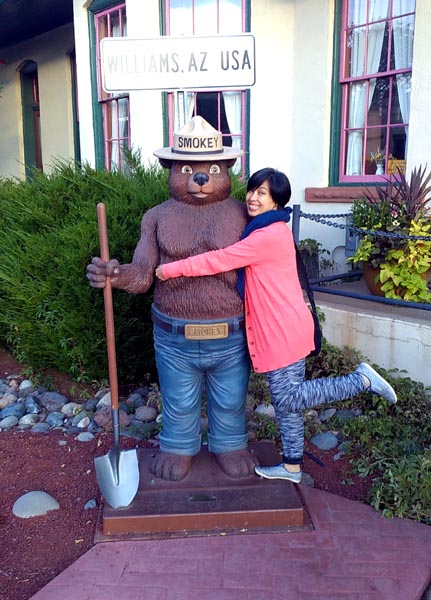 |
| My wife meets Smokey, Williams, Arizona (2015) |
Note: How a "spokesbear" rose from the ashes of a natural disaster to help prevent more such catastrophes.
Get Ready: Do you know of any public safety campaigns featuring animals as "spokesmen"?
 |
| Pecos Bill lassos a tornado (Wikipedia) |
Note: Americans used to love "big man tales," stories of larger-than-life figures: some entirely fictional, others based on legendary exploits of real men, and most associated with a particular profession. The lumberjacks had Paul Bunyan, the frontiersmen had Davy Crockett, and the cowboys had Pecos Bill.
Get Ready: Do "tall tales" of larger-than-life heroes serve an important function in society, or are they "just for fun"?
 |
| Clockwise from top left: John, Paul, Ringo, and George (Wikipedia) |
Note: In 1964, America was struck by BEATLEMANIA! In that year, the Lads from Liverpool landed on our shores. Read about them and their impact on music history.
Get Ready: Look at the picture of the Beatles above. Do you find their hairstyles shocking? Why or why not?
 |
| Happy birthday! (Wikipedia) |
Note: Please indulge the old Prof as he talks about his birthday (when he was a young pup of 53) and the people who share it.
Get Ready: How do you sing "Happy Birthday to You"? Do any of the versions below sound familiar?
 |
| Traditional Scots New Year's celebration (Wikipedia) |
Note: We continue the look at New Year's traditions that we began in Lesson #01-055. Let's dig a little deeper!
Get Ready: What is one thing about your life that you'd like to change? Is "making a resolution" a good way to do that?
 |
| "Tick tock" is onomatopoetic. This sign in Italy advertises a silent clock. (Wikipedia) |
Note: Like idioms, figures of speech are words or combinations of words that carry meaning or, as in this lesson, feelings beyond the words themselves. We'll meet four today, and two more very common ones in Lesson #01-030.
Get Ready: English speakers: What are some words used to indicate sounds, like "bang" or "meow"? Speakers of other languages: Do you have words in your language that are supposed to show a sound, like a gun going "bang" in English, or a cat saying "meow"?
 |
| A back-to-school sale in the U.S. (Wikipedia) |
Note: Some kids love school and some kids don't. Let's hear two friends discussing their school days.
Get Ready: Do (or did) you love school? Why or why not? What was your favorite subject?
 |
| In many countries, school starts in September (Wikipedia) |
Note: September. For many people, it means the start of a new school year. (After 18 years as a student and 26 as an educator, I have come to feel that "New Years Day" must be some time in September!)
Get Ready: Does September have any special significance for you? What month do you think is most important?


.jpg)


