 |
| A Jack Sparrow imitator (Wikipedia) |

Note: Another ship, another pile o' plunder, as we continue learnin' the tongue o' Long John Silver and his mates!
Get Ready: Have you ever watched a pirated movie, listened to pirated music, and so on?


|
| A Jack Sparrow imitator (Wikipedia) |
Note: Another ship, another pile o' plunder, as we continue learnin' the tongue o' Long John Silver and his mates!
Get Ready: Have you ever watched a pirated movie, listened to pirated music, and so on?
 |
| The founders of International Talk Like a Pirate Day (Wikipedia) |
Note: Ahoy, there, me hearties! Be ye able to talk like a pirate, ye lubber? Ye'd do well to lend an ear!
Get Ready: Have you ever noticed the way pirates talk in movies? What's unusual about it?
 |
| The eight parts of speech are hiding in this diagram. (Wikipedia) |
Note: All right, class. Settle down. Today I want you to memorize--yes, memorize--the functions of the eight parts of speech. (Okay, not really, but you should be very familiar with them.)
Get Ready: Look at the picture above and find as many of the eight parts of speech as you can. (Hint: There are five.)
 |
| A banking airplane; the Bank of England (Wikipedia: left, right) |
Note: In Lesson #01-064 I asked the "part of speech" of ten words, and explained that there's no way to know what part of speech a word is until we see the words in a sentence. Let's look at each word from that lesson more closely.
Get Ready: Look at the two words in the caption to the picture. Can you think of other words that can be both a verb and a noun, some with very different meanings?
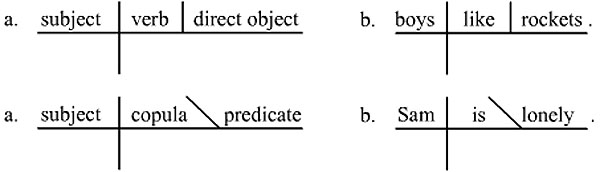 |
| Sentence diagramming (yuck!) illustrates parts of speech. (Wikipedia) |
Note: Studying grammar is soooo boring. And so important!
Get Ready: What is the "job" of a noun--that is, what does it do in a sentence? How about a verb? Or a preposition?
 |
| Maybe left? Maybe right? "Maybe" indicates uncertainty. (Wikipedia) |
Note: Sometimes things don't translate well from one language into another. We refer to these things as being "lost in translation." The way Chinese and Japanese people use the word "maybe" is a good example.
Get Ready: What does the word "maybe" mean to you? How do you use it?
 |
| Can you figure out what this sign means? (Wikipedia) |
Note: Remember, Amanda is a typical Chinese learner of English, but others can make these mistakes too! In any case, it's helpful to learn how to spot errors. Read Part I and Part II of this conversation.
Get Ready: What is a modal? What form of the verb should be used after a modal?
 |
| Can you spot the problem with this sign's English? (Wikipedia) |
Note: Because Amanda is a typical Chinese learner of English, you might not think the errors she makes relate to your learning. But it's always helpful to learn how to spot mistakes, even if you're not likely to make them yourself. Part I precedes this part of the conversation, and Part III follows it.
Get Ready: How many words are there in your language for aunt? In Chinese there are MANY, in English only one.
 |
| Can you spot the problem with this sign's English? (Wikipedia) |
Note: Although the mistakes Amanda makes below are typical for Chinese learners of English, others make them too! In any case, it's helpful to learn how to spot errors. Read Part II and Part III of this conversation when you're finished.
Get Ready: Is it ever okay to use a "be verb" and a "do verb" together? For example, "I am go to school" or "I was go to school"?
 |
| "I know a man with a wooden leg called Smith." "What was the name of his other leg?" --Mary Poppins (Wikipedia: leg, sticker) |
Note: We continue looking at the sometimes-humorous results of separating a noun from its adjective (or adjective phrase) and adverb (or adverb phrase).
Get Ready: What's funny about the photo caption above? How could you fix it?
 |
| "After ten years in prison, the governor pardoned the criminal." |
Note: Sometimes poor grammar isn't just wrong, it's downright hilarious! These problems with the placement of modifiers are good examples.
Get Ready: Can you spot the difference between a misplaced modifier and a dangling participle? (Hint: look for the -ing word!)
 |
| Political cartoons often use visual metaphors. Here, Napoleon is supported by the devil. (Wikipedia) |
Note: Similes and metaphors (and other figures of speech) can make your expression more colorful, whether you're a preacher, a poet, or a politician! (Alliteration!)
Get Ready: Do you know the difference between a simile and a metaphor?
 |
| "Tick tock" is onomatopoetic. This sign in Italy advertises a silent clock. (Wikipedia) |
Note: Like idioms, figures of speech are words or combinations of words that carry meaning or, as in this lesson, feelings beyond the words themselves. We'll meet four today, and two more very common ones in Lesson #01-030.
Get Ready: English speakers: What are some words used to indicate sounds, like "bang" or "meow"? Speakers of other languages: Do you have words in your language that are supposed to show a sound, like a gun going "bang" in English, or a cat saying "meow"?
 |
| Poster from a 1943 film (Wikipedia) |
Note: Most of our grammar "makes sense," but there are many special constructions that just can't be explained. One of these is in the for, "The ____er, the ___er" or something similar. We can call this a kind of "idiomatic grammar," where we break the rules of grammar for a special effect.
Get Ready: Do you know what "The sooner, the better" means? Or "The more, the merrier"? Have you heard other English sentences like this?
 |
| Edgar A. Guest (Wikipedia) |
Note: Some great writers--notably Mark Twain--write in English dialects that make their works difficult to read. Here are some tips on understanding their works.
Get Ready: In your language, is the spoken language different from the written language? Do people ever try to write as they speak, like English "wanna" for "want to" or "doin'" for "doing"?


